
September 18, 2026
Debt, Deficits, and Duration: The New Rate Reality
by Hans Krippaehne and Lev Marcus
Recent increases in long-term interest rates and actions of the current administration have renewed media attention on the sustainability of U.S. government debt and on rates more broadly. As a percentage of GDP, the debt load is at its highest level since World War II and is projected to keep rising. Debt sustainability has been a perennial topic for well over a decade, but today’s rate environment makes it feel like a more pressing issue. Let’s look at what’s going on, potential solutions, and how our portfolios are positioned.
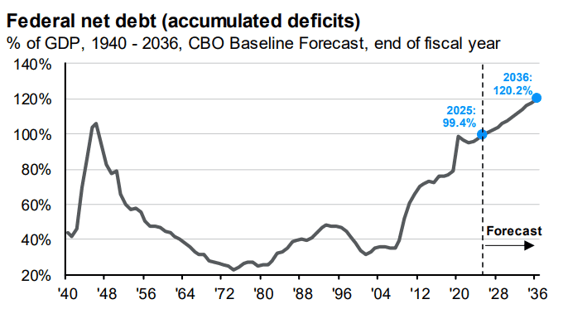
Source: J.P. Morgan Asset Management, CBO, Treasury Department. As of August 31,2026. Forecasts and projections are based upon current beliefs and expectations. They are for illustrative purposes only and serve as an indication of what may occur. Given the inherent uncertainties and risks associated with forecasts and projections, actual events, results or performance may differ materially from those reflected or contemplated
Government Debt
Default is unlikely and demand remains high.
First, the idea of an involuntary U.S. default is a misconception. Because the U.S. borrows in its own currency, it can always pay back lenders by printing more of that currency, so a default – missing an interest or principal payment – is highly unlikely. Most historical sovereign debt crises or defaults involved debtors borrowing in a foreign currency, which isn’t the case here. More importantly, institutional demand for U.S. Treasuries remains steady despite the government’s issuing more of them. At recent Treasury auctions the ratio of total bids received to total debt awarded has consistently cleared between 2.3x and 2.7x. In short, the government isn’t running out of buyers.
Continued economic strength
Media coverage tends to focus on the liability side of the government’s balance sheet without weighing the asset side. The U.S. economy remains one of the most dynamic globally, with an entrepreneurial culture, innovative companies, and rule of law. While that doesn’t mean the growing debt load should be ignored, these assets help contextualize the true fiscal health of the U.S.
Challenges
The composition of spending highlights the challenge in finding a viable solution to debt reduction. As the chart below shows, net interest, Social Security, and health care (Medicare and Medicaid) make up the majority of spending, and all are politically difficult to cut. A campaign based on cutting spending and/or raising taxes is rarely successful. Rising rates may eventually force Washington to act, but so far, the administration’s attempts to intervene in markets or jawbone investors have been unsuccessful. Solving the debt issue is simple in the sense that we know the levers – decrease spending, increase taxes, boost economic growth, increase inflation – and complex in that pulling them is, at best, politically difficult. The solution will likely be some combination of all four.
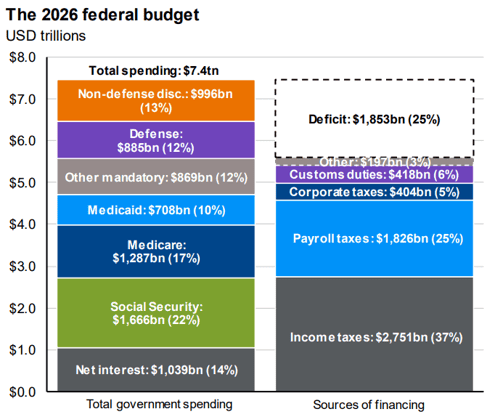
Source: J.P Morgan Asset Management, BEA, CBO, Treasury Department. As of August 31, 2026
Other factors influencing rates
While government deficits are fueling much of the current discussion, it is also important to consider other drivers of interest rates. First, the U.S. economy remains in solid shape, which is generally supportive of higher rates. Second, there are other significant borrowers competing for lenders’ money. Large corporations funding the buildout of AI infrastructure have increasingly turned to debt financing. In fact, according to JP Morgan strategist calculations, corporate borrowing so far in 2026 is nearly half as much as long duration treasury issuance. This is a meaningful amount of debt for investors to absorb. Lastly, inflation remaining stubbornly above the Fed’s target leads investors to demand higher interest as compensation.
For historical context, rates are at their highest levels since before the 2008 financial crisis. Importantly, the low interest rates of the 2010s, which many still think of as normal, may be the historical exception rather than the rule. From that perspective, the move to higher interest rates starting in 2022 could be described as a rebound of the interest rate environment from the lows of the 2010s and COVID-19 pandemic. Whether this marks a lasting shift in the direction of rates remains to be seen, but it’s a theme we discuss frequently and can’t rule out.
Bond Portfolio Positioning
Given this backdrop, this is a good time to revisit how our bond portfolios are positioned, particularly regarding duration and income.
The Duration Sweet Spot
Duration, measured in years, is one of the most important factors in any bond portfolio. It measures how sensitive a bond’s price is to changes in interest rates. For example, a bond with a duration of five years would be expected to lose about 5% of its value if interest rates rise by one percentage point, and gain about 5% if they fall by the same amount.
This means that, while higher yields on long-term bonds may be enticing, their price volatility can rival that of stocks. Conversely, short-term holdings like money market funds avoid that volatility but expose investors to reinvestment risk: when those short-term investments mature, you have to reinvest the proceeds at whatever rate is available then, and if rates have fallen, your income falls with them.
Given those risks, in our core bond allocation we emphasize high-quality bonds with an intermediate-term average duration (four to five years). Historically, 5-year Treasuries have captured approximately 80% of the yield of 30-year bonds with roughly 28% of the duration risk, dramatically reducing volatility and drawdown risk.
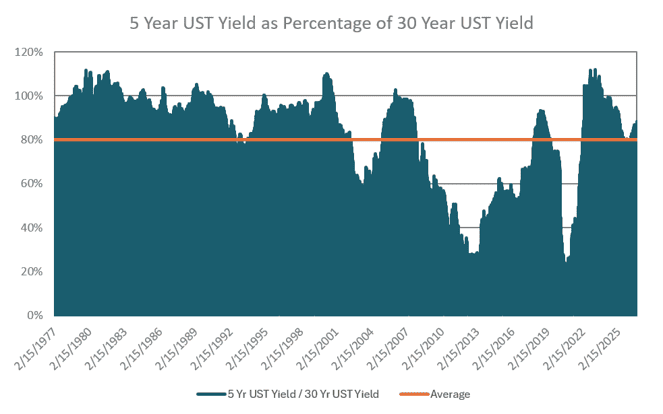
Sources: FRED, Bloomberg. Fulcrum calculations
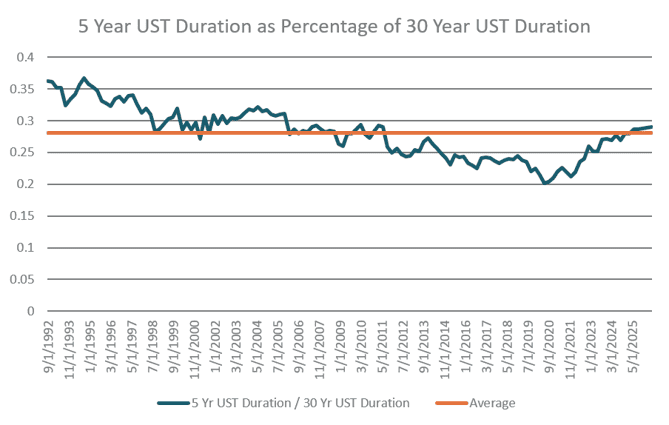
Sources: FRED, Bloomberg. Fulcrum calculations
Income Beyond the Core
We start with a core allocation to investment-grade bonds, then add higher-yielding strategies including high yield bonds, insurance-linked securities, income-oriented real estate, and private credit. These sectors typically offer higher yields than core bonds to compensate for additional risks, such as credit risk and liquidity risk. Importantly, they have also historically been less sensitive to changes in interest rates, which helps diversify the interest rate risk in our core bond holdings.
We also have flexibility to make tactical adjustments as risks or opportunities arise. U.S. 10-year Treasury rates are approaching levels last seen in late 2023, when there was also quite a bit of media attention and handwringing as they approached 5%. But rates near these levels have generally been attractive entry points in recent years. Our current positioning already reflects that view, so we do not see a need for a tactical adjustment today.
Bonds provide portfolio stability, but on their own they can’t keep pace with inflation’s erosion of purchasing power over time. That is where stocks come in. Stocks aren’t immune to interest rate changes either, as 2022 showed, when rising rates pushed both stocks and bonds sharply lower. Higher rates raise companies’ borrowing costs and reduce what investors are willing to pay today for future earnings. That is one reason we favor high-quality, growing companies with pricing power and strong, efficient profitability – companies that can pass rising costs on to customers and rely less on borrowing, so they should hold up better when interest rates rise.
A durable financial plan does not depend on Washington balancing its budget or the Fed predicting the exact path of interest rates. Instead, it relies on thoughtful asset allocation that turns market mechanics to your advantage.
The questions surrounding government debt, deficits, inflation, and interest rates are important, and they deserve attention. However, they are only a few of the many variables that influence markets over time. Economic growth, corporate investment, investor sentiment, and increasingly, policy-driven market actions can all affect the path of interest rates and asset prices.
By balancing defensive intermediate duration, diversified private credit, and resilient stocks, portfolio capital should remain productive, insulated, and aligned with your long-term wealth objectives.
We appreciate the trust you place in us. Financial markets will continue to present new challenges, new opportunities, and no shortage of headlines competing for attention. Our commitment is to help separate signal from noise, remain focused on what matters most, and serve as a thoughtful partner in helping you achieve your financial objectives.
As always, if you would like to discuss any of the topics covered here or how they relate to your own financial plan and investment strategy, we welcome the conversation.
Unless otherwise noted, data presented in this report is from recognized financial and statistical reporting services or similar sources including but not limited to Reuters, Bloomberg, the Bureau of Labor Statistics, or the Federal Reserve. While the information above is obtained from reliable sources, we do not guarantee its accuracy. This report is limited to the dissemination of general information pertaining to Fulcrum Capital, LLC, including information about our advisory services, investment philosophy, and general economic and market conditions. This communication contains information that is not suitable for everyone and should not be construed as personalized investment advice. Past results are not an indication of future performance. This report is not intended to be either an expressed or implied guarantee of actual performance, and there is no guarantee that the views and opinions expressed above will come to pass. It is not intended to supply tax or legal advice, and there is no solicitation to buy or sell securities or engage in a particular investment strategy. Individual client needs, allocations, and investment strategies differ based on a variety of factors. Any reference to a market index is included for illustrative purposes only, as it is not possible to directly invest in an index. Indices are unmanaged, hypothetical vehicles that serve as market indicators. Index performance does not include the deduction of fees or transaction costs which otherwise reduce performance of an actual portfolio. This information is subject to change without notice. Fulcrum Capital, LLC is an SEC registered investment adviser with its principal place of business in the state of Washington. For additional information about Fulcrum Capital please request our disclosure brochure using the contact information below.