
April 29, 2026
Beyond the Hype: Understanding Blockchain Impact
by Lev Marcus
Over the last decade, few topics have generated as much hype as cryptocurrencies. While these “stores of value” are often dominated by large price swings and wild speculation, blockchain, the underlying digital innovation, has utility across a wide spectrum of applications.
The Technology
At its simplest, blockchain is akin to a shared notebook or ledger, where each page is a list of transactions, and everyone holds an identical copy. Because all records must match to chain these transactions together, the data cannot be easily erased or faked.
A deep technical understanding of the specifics behind blockchain and Bitcoin is not required to see why this type of tamper-resistant, self-auditing system is useful in a digital world.* However, a gap still exists between theory and practice. For example, Bitcoin still requires several minutes to settle a transaction, whereas a major credit card network can do so nearly instantaneously. Additionally, trust in a payment network is built over time through timely and accurate execution. It also requires mechanisms for resolution of errors, and that is still nascent for cryptocurrencies.
As a growing technology, new cryptocurrencies are attempting to solve various financial problems related to transferring value over the internet. While we in the United States benefit from the largest and most complex financial institutions in the world, many developing economies have limited banking infrastructure. In those regions, remittances often come with high fees and volatile local currencies, and cryptocurrencies can offer lower transaction fees and less volatility. This allows them to retain purchasing power, providing incredible utility in these economies.
This utility has not gone unnoticed. Major institutions like Mastercard, Fidelity, and PayPal have launched their own blockchain projects. Institutions such as the Bank of International Settlements recently addressed the use of stablecoins and the “tokenization” of assets (the process of pairing a digital token with a physical asset, such as dividing a U.S. Treasury bill into smaller, digital fractions) for monetary policy.
The Asset
“Digital Assets” is the broadest term, encompassing cryptocurrencies, stablecoins, tokenized assets, and non-fungible tokens (NFTs) Major digital assets like Bitcoin, Ethereum, and Solana have already been integrated into traditional capital markets via Exchange Traded Funds (ETFs). Integration is becoming so seamless that platforms like Yahoo Finance now offer one-click buttons to trade via the Coinbase exchange.
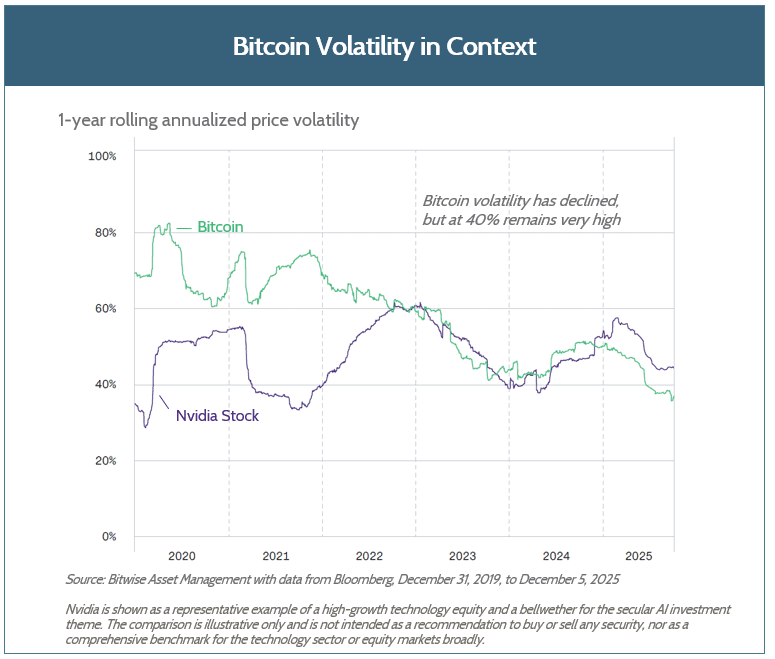
However, valuing a digital asset is fundamentally different from valuing a stock or a bond. Unlike traditional assets, there are no future cash flows to forecast. Because there is no “fundamental anchor” for the price, these assets can swing wildly—experiencing severe drawdowns, sometimes without recovery.
From a portfolio perspective, this volatility is critical. Even a small allocation can meaningfully increase total portfolio volatility, particularly as some of the major cryptocurrencies increasingly move in similar directions as stocks. While increased adoption and liquidity may lower this volatility over time, for investors today, risk control is paramount.
Many index investors may be surprised to learn they already have “stealth” exposure. Large stock market index funds contain exposure to Bitcoin through the holdings of underlying companies, though it is generally less than one percent. Some of these companies use digital assets in daily operations, while others have leveraged their balance sheets to acquire massive amounts of Bitcoin.
At Fulcrum, we strive for intellectual humility and recognize that the financial world is continuously evolving. We don’t believe in ignoring innovation, but we do believe in managing it. By distinguishing the signal (technological utility) from the noise (market volatility), we can explore how this new technology influences markets across the globe.
* For a base technical understanding of the underpinning of blockchain and bitcoin, check out 3Blue1Brown’s simple and visual explanation: https://www.youtube.com/watch?v=bBC-nXj3Ng4&vl=en
This communication contains information that is not suitable for everyone and should not be construed as personalized investment advice. It is not intended to supply tax or legal advice, and there is no solicitation to buy or sell securities or engage in a particular investment strategy. Individual client needs, allocations, and investment strategies differ based on a variety of factors. This information is subject to change without notice. Fulcrum Capital, LLC is an SEC registered investment adviser with its principal place of business in the state of Washington. For additional information about Fulcrum Capital please request our disclosure brochure using the contact information below.